
- How to Migrate from Rank Math to SureRank
- How to Migrate from Yoast to SureRank
- How to Migrate from SEOPress to SureRank SEO
- How to Migrate from Squirrly SEO to SureRank
- How to Migrate from All in One SEO (AIOSEO) to SureRank
- How to Migrate from Slim SEO to SureRank
- Migration Failed: How to Diagnose
- After You Migrate: Verification and Cleanup Checklist
- Sitemaps in SureRank
- How to Enable Video Sitemap in SureRank Pro
- How to Enable the News Sitemap in SureRank
- How to Show the HTML Sitemap on Your Site in SureRank Pro
- How to Regenerate the Sitemap After Excluding a Post Type in SureRank
- Change the Sitemap URL in SureRank
- How to Enable Author Sitemap in SureRank
- How to Exclude Post Types from the Sitemap
- How to Enable the Author Sitemap and Why Authors Are Excluded (Pro)
- Editing Meta Box
- SureRank – Page SEO Checks
- Enabling Page SEO Checks in WordPress
- Image Alt Text – Automatic Optimization
- Link Manager
- Using the SureRank Front-End Meta Box
- How to Edit the Meta Title and Description for a Single Page or Post
- Controlling Indexing with Robot Instructions
- How to Set Global Title and Description Templates with Variables
- How to Set a Canonical URL and How the Canonical Field Works
- How to Set the Homepage, Shop, and Archive Title & Description
- Setting Up Site Information for Google’s Knowledge Panel
- Social Settings: Facebook/Open Graph, X (Twitter) Cards, and Profile Links
- Why Do My Image Links Redirect to a Blog Post or My Homepage?
- How to Fix WWW and Non-WWW Version Redirects to Improve Your SEO
- How to Fix: No H1 Heading Found on Your Homepage
- How to Fix Missing H2 Headings on Your Homepage
- Re-run Checks Button in SureRank
- Fix Critical Error: Another SEO Plugin Detected in SureRank
- Fix Warning: Site Tagline Is Not Set in SureRank
- How to Fix: Robots.txt Contains Invalid Rules in SureRank
- How to Fix Multiple SEO Plugins Detected on Your Site
- How to Fix: Homepage is Not Indexable by Search Engines
- Warning: Homepage Does Not Contain Internal Links
- How to Fix: Search Engine Title is Missing on the Page
- Page Level SEO: Broken Links Detected
- How to Fix Missing Alt Text on Images
- How to Fix Page URLs That Are Too Long
- Page Level SEO Warning: No Links Found on This Page
- Page Level SEO Warning: No Images or Videos Found
- Page Level SEO Warning: Missing Search Engine Description
- Page Level SEO Warning: No Subheadings Found on This Page
- Page Level SEO Warning: Canonical Tag is Missing
- Page Level SEO Warning: Open Graph Tags Missing
- What is Google Search Console and how does SureRank use it?
- Recommended Image Sizes
- SureRank – SEO Check Severity Guide
- Using SureRank with Other SEO Plugins – Best Practices
- Import/Export Feature – SureRank Plugin
- What is llms.txt and Does SureRank Support It?
- Does SureRank offer a keyword rank-tracking feature?
- Does SureRank Come With Google Analytics Integration?
- Email Summary in SureRank
- SureRank Role Manager
- Search Engines Not Indexing Your WordPress Site?
- Sitemap Not Showing in SureRank
- Fixing robots.txt Issues in SureRank
- Why a Working Link Is Flagged as Broken (404)
- Which Pages Are Included in Your SureRank Sitemap
- Fixing False SEO Audit Warnings Caused by Caching
- Fixing “Couldn’t Fetch” for Your Sitemap in Google Search Console
- Troubleshooting: Favicon and Logo in Google Search Results (Supported Formats and CDN Gotchas)
- Customize XML Sitemap Top Bar with surerank_sitemap_top_bar_data
- Analyze ACF Field Content with SureRank
- Preserve Modified Date During Updates surerank_freeze_modified_date
- Customize Final Title Tag surerank_final_title
- Customize Post Type Archive Title Output surerank_post_type_archive_title
- Customize Archive Page Title with surerank_archive_title
- CustomizeModify the Search Results Page Title surerank_search_title
- Customizing the 404 Page Title surerank_not_found_title
- Customizing the Title Separator surerank_title_separator
- How to Remove Archive Prefixes from Titles Using SureRank
How to Set Global Title and Description Templates with Variables
Overview
SureRank generates each page’s meta title and description from a template made of plain text and variables, tokens wrapped in %…%, that get swapped for real content such as the post title, site name, or current year. One global template applies across your entire site unless a specific post or term has its own custom title or description.
Where to Find It
SureRank → General → Meta Templates
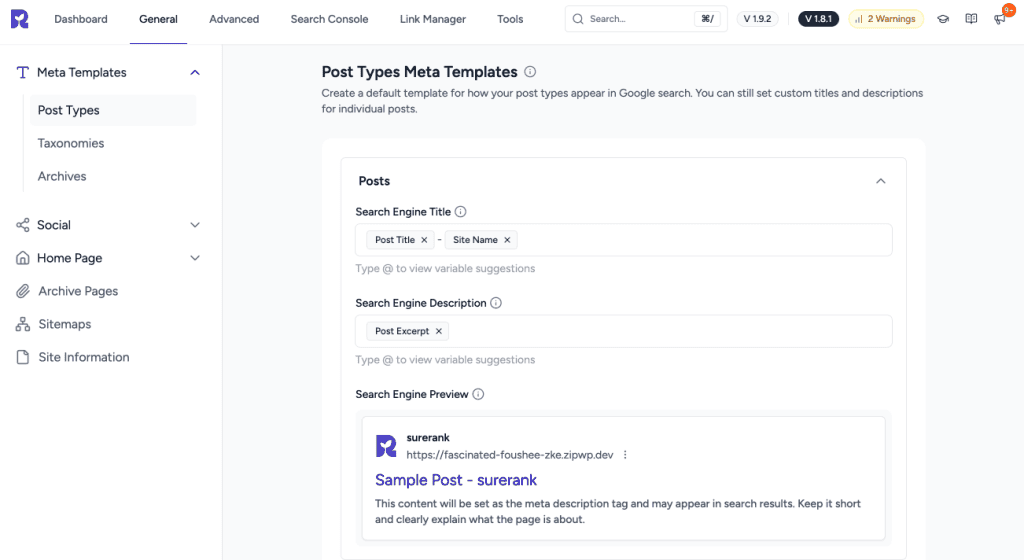
There are two fields:
- Search Engine Title: default is %title% – %site_name%
- Search Engine Description: default is %content%
This page controls the sitewide default template used for posts and pages without a custom title or description.
The homepage has its own separate defaults, editable independently at SureRank → General → Home Page → General.
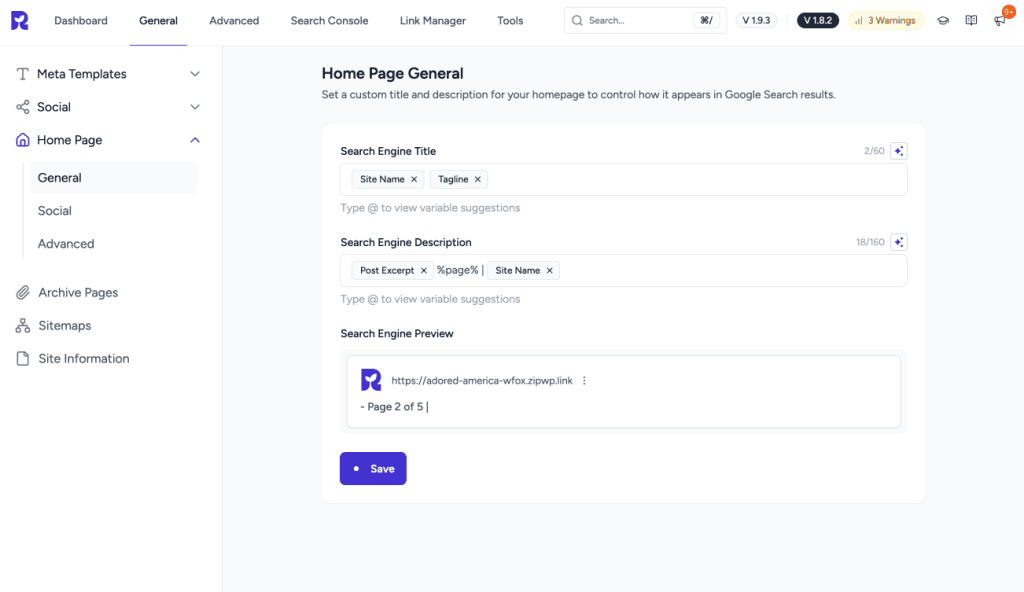
Steps for the Customer
- Go to SureRank → General → Meta Templates.
- Click into the Search Engine Title field and type @ at any point.
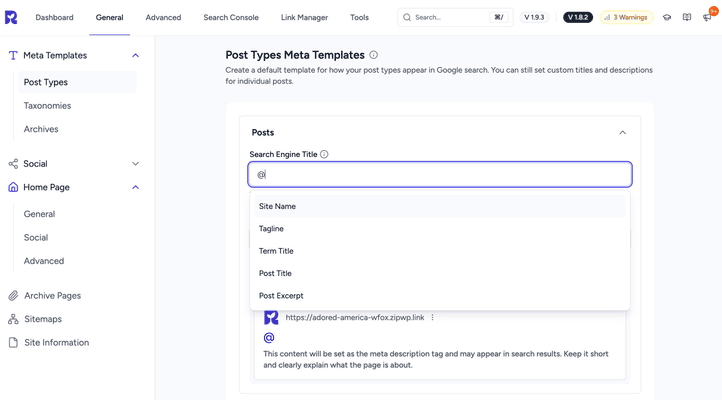
- A variable picker opens so you can insert a dynamic variable without memorizing the syntax.
- Repeat for the Search Engine Description field.
- Watch the Search Engine Preview panel below the fields. It updates live to show how the title and description will look in Google search results as you type.
- Click Save.
Available Variables
| Variable | Resolves to |
| %title% | Post/page title |
| %excerpt% | Post excerpt |
| %content% | Post content |
| %site_name% | Your site’s name |
| %tagline% | Your site’s tagline |
| %permalink% | The page’s URL |
| %published% | Date published |
| %modified% | Date last modified |
| %term_title% | Category/tag name (on term archives) |
| %term_description% | Category/tag description |
| %author_name% | Author’s display name |
| %author_description% | Author’s bio |
| %currentdate%, %currentday%, %currentmonth%, %currentyear%, %currenttime% | Today’s date/time components |
| %org_name%, %org_logo%, %org_url% | Organization details (from Local SEO/schema settings) |
| %custom_field.your_field_name% | Any custom field value. Replace your_field_name with the actual field key. |
Variable names are exact and case-sensitive. For example, it’s %currentyear%, not %current_year%.
One Template, Context-Aware
The same global template is reused everywhere, but %title% and %excerpt% intelligently resolve based on where they’re used:
- On a blog post or page: %title% = post title, %excerpt% = post excerpt
- On a category or tag archive: %title% = term name, %excerpt% = term description
- On an author archive: %title% = author’s name, %excerpt% = author’s bio
Does a Post’s Own Title Override This?
Yes. If a specific post, page, or term has its own custom title or description set, that always overrides the global template for that one item. The global template only fills in items left blank.
Free vs. Pro
On Free, this one global template applies across every post type and taxonomy. Pro adds separate templates per post type and per taxonomy (for example, a distinct template just for Products versus Blog Posts) for more granular control.
Troubleshooting
Live preview shows the raw %variable% text instead of resolving it
Check for a typo. Variable names must match exactly.
A page still shows the old title/description after you changed the template
Check whether that specific post has its own custom title or description overriding the sitewide template.
Variables resolve to blank or incorrect values across many posts consistently
Escalate. This can indicate a caching or data issue rather than a template mistake.
We don't respond to the article feedback, we use it to improve our support content.