
- How to Migrate from Rank Math to SureRank
- How to Migrate from Yoast to SureRank
- How to Migrate from SEOPress to SureRank SEO
- How to Migrate from Squirrly SEO to SureRank
- How to Migrate from All in One SEO (AIOSEO) to SureRank
- How to Migrate from Slim SEO to SureRank
- How to Migrate from The SEO Framework to SureRank
- Migration Failed: How to Diagnose
- After You Migrate: Verification and Cleanup Checklist
- Sitemaps in SureRank
- How to Enable Video Sitemap in SureRank Pro
- How to Enable the News Sitemap in SureRank
- How to Show the HTML Sitemap on Your Site in SureRank Pro
- How to Regenerate the Sitemap After Excluding a Post Type in SureRank
- Change the Sitemap URL in SureRank
- How to Enable Author Sitemap in SureRank
- How to Exclude Post Types from the Sitemap
- How to Enable the Author Sitemap and Why Authors Are Excluded (Pro)
- Editing Meta Box
- SureRank – Page SEO Checks
- Enabling Page SEO Checks in WordPress
- Image Alt Text – Automatic Optimization
- Link Manager
- Using the SureRank Front-End Meta Box
- How to Edit the Meta Title and Description for a Single Page or Post
- Controlling Indexing with Robot Instructions
- How to Set Global Title and Description Templates with Variables
- How to Set a Canonical URL and How the Canonical Field Works
- How to Fix WWW and Non-WWW Version Redirects to Improve Your SEO
- How to Fix: No H1 Heading Found on Your Homepage
- How to Fix Missing H2 Headings on Your Homepage
- Re-run Checks Button in SureRank
- Fix Critical Error: Another SEO Plugin Detected in SureRank
- Fix Warning: Site Tagline Is Not Set in SureRank
- How to Fix: Robots.txt Contains Invalid Rules in SureRank
- How to Fix Multiple SEO Plugins Detected on Your Site
- How to Fix: Homepage is Not Indexable by Search Engines
- Warning: Homepage Does Not Contain Internal Links
- How to Fix: Search Engine Title is Missing on the Page
- Page Level SEO: Broken Links Detected
- How to Fix Missing Alt Text on Images
- How to Fix Page URLs That Are Too Long
- Page Level SEO Warning: No Links Found on This Page
- Page Level SEO Warning: No Images or Videos Found
- Page Level SEO Warning: Missing Search Engine Description
- Page Level SEO Warning: No Subheadings Found on This Page
- Page Level SEO Warning: Canonical Tag is Missing
- Page Level SEO Warning: Open Graph Tags Missing
- What is Google Search Console and how does SureRank use it?
- Recommended Image Sizes
- SureRank – SEO Check Severity Guide
- Using SureRank with Other SEO Plugins – Best Practices
- Import/Export Feature – SureRank Plugin
- What is llms.txt and Does SureRank Support It?
- Does SureRank offer a keyword rank-tracking feature?
- Does SureRank Come With Google Analytics Integration?
- Email Summary in SureRank
- SureRank Role Manager
- Fixing a Fatal Error After Updating SureRank
- SureRank Server Requirements
- Search Engines Not Indexing Your WordPress Site?
- Sitemap Not Showing in SureRank
- Fixing robots.txt Issues in SureRank
- Why a Working Link Is Flagged as Broken (404)
- Which Pages Are Included in Your SureRank Sitemap
- Fixing False SEO Audit Warnings Caused by Caching
- Fixing “Couldn’t Fetch” for Your Sitemap in Google Search Console
- Troubleshooting: Favicon and Logo in Google Search Results (Supported Formats and CDN Gotchas)
- Customize XML Sitemap Top Bar with surerank_sitemap_top_bar_data
- Analyze ACF Field Content with SureRank
- Preserve Modified Date During Updates surerank_freeze_modified_date
- Customize Final Title Tag surerank_final_title
- Customize Post Type Archive Title Output surerank_post_type_archive_title
- Customize Archive Page Title with surerank_archive_title
- Customize the Search Results Page Title surerank_search_title
- Customizing the 404 Page Title surerank_not_found_title
- Customizing the Title Separator surerank_title_separator
- Disable SureRank’s Document Title Integration
- What Is AI Ready in SureRank?
- How to Fix the Indexing and Snippet Rules Result in SureRank AI Ready Checks
- How to Fix the Home Page Text Without JavaScript Result in SureRank AI Ready Checks
- How to Handle the OAuth Discovery Result in SureRank AI Ready Checks
- How to Handle the A2A Agent Card Result in SureRank AI Ready Checks
- How to Handle the Web Bot Auth Result in SureRank AI Ready Checks
- How to Fix the Site Slow and Site Unreachable Results in SureRank AI Ready Checks
- How to Fix the llms.txt Result in SureRank AI Ready Checks
- How to Fix the Content Signals Result in SureRank AI Ready Checks
- How to Fix the MCP Server Card Result in SureRank AI Ready Checks
- How to Fix the Agent Skills Index Result in SureRank AI Ready Checks
- How to Fix the auth.md Result in SureRank AI Ready Checks
- How to Fix the AI Catalog Result in SureRank AI Ready Checks
- How to Fix the Personal Agent Protocol Result in SureRank AI Ready Checks
- What Each AI Ready Check Means in SureRank
- How to Run AI Ready Checks and Fix the Results in SureRank
- How to Set Content Signals in SureRank
- How to Publish Agent Discovery Files in SureRank
- How to Fix a 403 on /.well-known/ Addresses
- How to Add DNS Agent Discovery Records
- Troubleshooting: Markdown, Link Header, or WebMCP Not Showing in AI Ready Checks
- How to Improve Your isitagentready.com Result With SureRank
What Each AI Ready Check Means in SureRank
AI Ready Checks tests 20 things about what a crawler or AI agent receives from a site. This doc explains each check, what a passing result looks like, and how to fix a result that does not pass.
Requirements
- SureRank and SureRank Premium, both active and updated to the latest versions
- An active SureRank Premium license (Pro, Starter, or Business). Upgrade here
- AI Ready turned on. See: How to Enable Markdown Copies in SureRank Premium.
How to Use This Doc
This section explains how the checks are listed on screen. The checks are in SureRank → AI Ready → AI Ready Checks. To run them and use the buttons on each row, see : How to Run AI Ready Checks and Fix the Results in SureRank.
If you’re looking for the meaning of a specific row, find its name in the headings below. Each heading matches the title of the panel that opens from the arrow button on that row.
Every check below has the same three parts:
- What it checks: what SureRank looks at.
- Passes when: what a Passed row looks like.
- If it does not pass: why the row shows another label, and what to do.
Crawler Basics
These four checks look at whether crawlers can reach the site and read its pages. They come first because a problem here keeps crawlers out regardless of anything else.
Robots.txt Is Readable
- What it checks: Whether the
robots.txtfile at the root of the domain can be read, and whether it has a Sitemap line that points to the XML sitemap. - Passes when: The row reads “Robots.txt is readable and points to your sitemap.”
If it does not pass:
- An empty file gives a Critical row, because it tells crawlers nothing, not even where the sitemap is.
- A server error (HTTP 5xx) gives a Critical row, because crawlers treat it as a request to stay off the whole site.
- A missing file (for example HTTP 404), or a file without a Sitemap line, gives a Warning row.
- To change the file, click the link in the panel, or go to SureRank → Advanced → Robots.txt Editor. If a real
robots.txtfile sits in the root folder of the site, the server sends that file instead, so it has to be edited there.
AI Crawler Access
- What it checks: Which AI crawlers the
robots.txtfile allows or blocks. The panel lists every crawler SureRank recognizes in three groups: crawlers that feed AI answers, crawlers that fetch a page when a person asks an assistant, and crawlers that train models. - Passes when: The row reads “Every crawler is allowed to read your site.”
If it does not pass:
- Critical: A crawler that feeds AI answers is blocked (for example OAI-SearchBot), or
robots.txtturns away every crawler with Disallow: / under User-agent: *. - Warning: Only crawlers outside those groups are blocked: training crawlers (for example GPTBot), crawlers that fetch a page when a person asks, or crawlers SureRank does not recognize.
- Blocking a training crawler is a licensing choice. The panel shows it so the rule is visible.
- To change the rules, click the link in the panel, or go to SureRank → Advanced → Robots.txt Editor. Rules that were not written in SureRank usually come from the hosting panel or a security plugin, and have to be changed there.
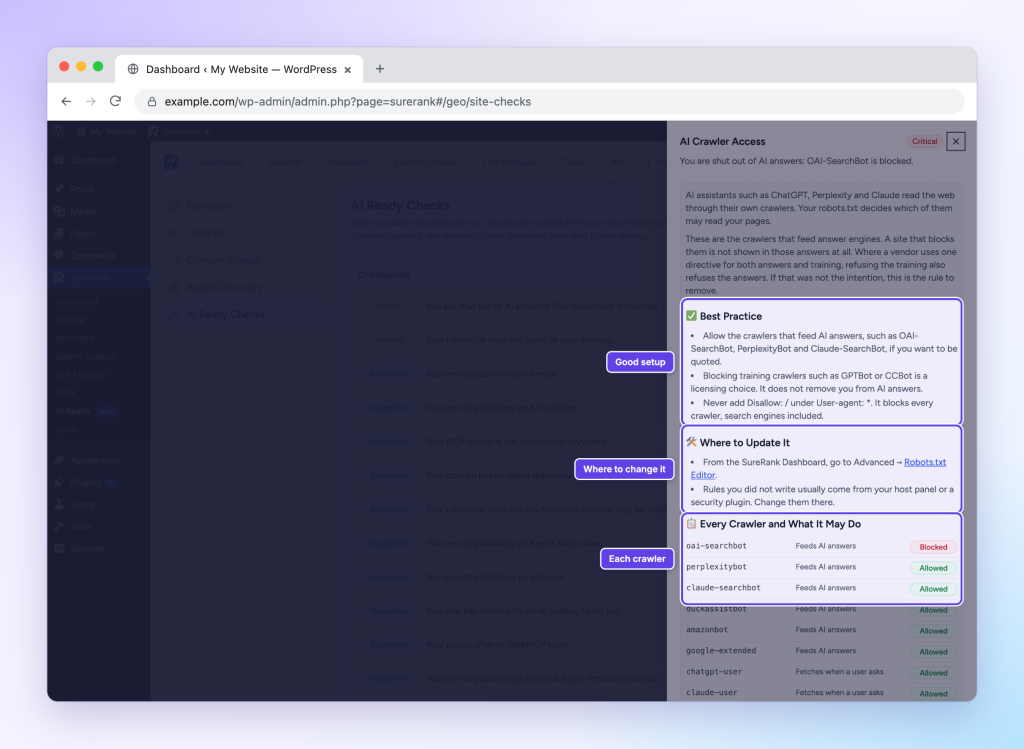
The panel lists Every Crawler and What It May Do, and each crawler is marked Allowed or Blocked.
Indexing and Snippet Rules on the Home Page
- What it checks: Whether the home page tells crawlers not to index or quote it. SureRank looks at the robots meta tag in the page and at the X-Robots-Tag header the server sends. It also reads the meta tags and headers that are meant for one crawler only, such as googlebot, bingbot, and the AI crawlers.
- Passes when: The row reads “Your home page lets crawlers index and quote it.”
If it does not pass:
- A Warning row appears when a rule is found. In the X-Robots-Tag header, SureRank looks for noindex, none, nosnippet, and max-snippet:0. A header sent on more than one line is read line by line, so a crawler name on one line does not apply to the next line. In the robots meta tag, it looks for nosnippet and max-snippet:0. In a meta tag meant for one crawler (Googlebot, Bingbot, or an AI crawler), it looks for noindex, none, and nosnippet. The row lists what was found, and names the crawler when the rule is meant for one crawler only, for example “googlebot meta tag”. A noindex in the robots meta tag is not reported here, because the Site SEO Checks already report it.
- A header comes from the host, a CDN, or a security plugin. Staging copies of a site often send X-Robots-Tag: noindex, so it is worth confirming that the live site does not.
- If the rule was not added on purpose, ask the host or check the security plugin settings.
Home Page Text Without JavaScript
- What it checks: Whether the main text of the home page is in the HTML the server sends. Many AI crawlers do not run JavaScript, so text that appears only after a script runs is invisible to them.
- Passes when: The row reads “Your home page carries its text without JavaScript” and shows the number of words found.
If it does not pass:
- A Warning row appears when the home page arrives with almost no text.
- A Critical row appears when the home page answers with an HTTP error. A maintenance or coming-soon plugin is the usual cause.
- Put the main text of the home page in the page content itself, and avoid sliders, tabs, or blocks that load their text after the page opens. To check, open the home page, view its page source, and look for the text.
Content for AI
These three checks look at the files and rules that tell AI tools how to read the content of the site and what they may do with it.
llms.txt
- What it checks: Whether /llms.txt is published. llms.txt is a short file that lists the most useful pages of a site with a line about each, written for language models. It is a proposal, and no AI vendor has documented reading it yet.
- Passes when: The row reads “An llms.txt is being served.”
If it does not pass:
- A Suggestion row appears when the file is not published. Nothing fails without one, so it is shown as something that can be added.
- A Suggestion row also appears while Discourage search engines from indexing this site is turned on under Settings → Reading. SureRank does not publish the file until that setting is cleared. Click Fix It For Me to turn that setting off.
- A Warning row appears when the file is turned on but the address answers with an error, or when something else answers at /llms.txt. A Plain permalink structure on some servers, another plugin, a rule on the server, or a catch-all route in the theme can cause this. If the row mentions Plain permalinks, first ask the developer or the host to check the redirects and to take a backup, because changing the permalink structure changes the address of every post and page. Then choose any other structure under Settings → Permalinks.
- To turn the file on, click Fix It For Me, or go to SureRank → AI Ready → LLMs.txt.
Markdown for Agents
- What it checks: Whether the home page answers a request for Markdown. An agent can ask any page for Markdown by sending Accept: text/markdown, and a site that answers gets the page as clean text without menus, scripts, or layout.
- Passes when: The row reads “Your pages answer a request for Markdown with Markdown.”
If it does not pass:
- A Suggestion row appears when the pages do not answer a request for Markdown. Agents then get the full HTML page.
- A Warning row appears when Markdown is on but the home page answered with HTML. Either the home page is left out of Markdown (its post type is not selected, or it is set to noindex), or a page cache in front of WordPress answered with the HTML it stored.
- To change the settings, go to SureRank → AI Ready → Markdown. If a page cache is in use, clear it and run the checks again.
Content Signals
- What it checks: Whether robots.txt says how the content may be used: for search, for AI answers (ai-input), and for model training (ai-train).
- Passes when: The row reads “Your robots.txt states how your content may be used” and lists the three values, for example search=yes, ai-input=yes, ai-train=no. SureRank reads the line under User-agent: *, and writes it into every group of the file, because a crawler that has a group of its own reads only that group.
If it does not pass:
- A Suggestion row appears when robots.txt does not carry the line. Click Fix It For Me, or go to SureRank → AI Ready → Content Signals.
- When robots.txt is a real file on the server, SureRank cannot add the line. The panel shows the line to add under User-agent: * in that file. The same applies to a site that is installed in a subdirectory.
- A Suggestion row appears while Discourage search engines from indexing this site is turned on, because SureRank keeps the line out of robots.txt until that setting is cleared. Click Fix It For Me to turn that setting off.
- A Warning row appears when Content Signals are on but the line is missing from the file the server sends. Another plugin or a rule on the server is replacing the robots.txt that WordPress builds.
- Saying yes to search and ai-input and no to ai-train keeps the site in AI answers while opting out of training.
Agent Discovery Files
These nine checks look at the files an AI agent reads to find out what a site offers. Most of them are published at addresses under /.well-known/, which only work at the root of a domain. A site that is installed in a subdirectory cannot publish them, and some servers block these addresses before WordPress runs.
Each file has a switch under SureRank → AI Ready → Agent Discovery. Fix It For Me turns the same switch on.
Discovery Link Headers
- What it checks: Whether the Link header on the home page points agents to something useful, such as the Markdown copy, the sitemap, or the API catalog.
- Passes when: The row reads “Your home page Link header points agents to:” followed by the list, for example “Markdown, sitemap.”
If it does not pass:
- A Suggestion row appears when the header does not point anywhere.
- Turning on Markdown adds the Markdown and sitemap links. Publishing the API catalog adds the api-catalog link.
API Catalog
- What it checks: Whether
/.well-known/api-catalogis published. This standard file (RFC 9727) tells an agent where the API of the site is and where its documentation lives. It lists APIs only. - Passes when: The row reads “Your API catalog is being served, so agents can find your site’s API.”
If it does not pass:
- A Suggestion row appears when the file is not published. SureRank builds it from what WordPress already knows, with nothing to fill in.
- A Warning row appears when the address does not reach SureRank, for example because the server answers /.well-known/ itself.
- A Warning row that reads “Something else is answering at
/.well-known/api-catalog.” also appears when the file is served but is not a usable catalog. Every entry in the linkset list needs at least one link, and each link needs an href. An entry added with thesurerank_pro_api_catalog_entriesfilter that has only an anchor makes the check fail.
MCP Server Card
- What it checks: Whether the site announces its MCP server, so an AI client can find it without being given the address. This row appears only while the MCP server is on.
- Passes when: The row reads “Your MCP server card is being served.” The card is served at /.well-known/mcp/server-card.json, and also at two other addresses that clients look for.
If it does not pass:
- A Suggestion row reads “Your MCP server is not announced anywhere.” Click Fix It For Me.
- A Warning row appears when the address does not reach SureRank.
- SureRank stops serving the card when the MCP server is switched off.
MCP Server
- What it checks: Whether the MCP server of the site is registered and on. An MCP server lets AI assistants work with the SEO data of the site through tools. It needs the WordPress MCP Adapter plugin.
- Passes when: The row reads “Your MCP server is registered and switched on.”
If it does not pass:
- When the adapter plugin is not installed, the row reads “Your MCP server is switched off, and the adapter it needs is not installed.” Install and activate the WordPress MCP Adapter plugin first.
- When the adapter is installed but the server is off, the row reads “Your MCP server is switched off.” Click Fix It For Me, or go to SureRank → Tools → MCP.
- When MCP is on but the adapter is missing, the row reads “MCP is on, but the adapter it needs is not installed.” Install and activate the WordPress MCP Adapter plugin.
- When WordPress is older than 6.9, the row reads “MCP is on, but WordPress is too old to run it.” The adapter needs the Abilities API, which WordPress added in version 6.9, so update WordPress.
- When a plugin or custom code switches the server off, the row reads “MCP is on, but code on your site has switched the server off.” Ask the developer to remove or change the code that returns false from the surerank_mcp_server_enabled filter.
- After turning it on, click Run Checks to confirm that the server registered.
Agent Skills Index
- What it checks: Whether
/.well-known/agent-skills/index.jsonis published. This file lists short instruction files (SKILL.md) an agent can follow to use the site, such as reading it as Markdown, using its API, or connecting to its MCP server. - Passes when: The row reads “Your Agent Skills index is being served.”
If it does not pass:
- A Suggestion row appears when the index is not published. SureRank builds it from the features that are switched on, so it lists only skills that apply.
- A Warning row appears when the index lists skill files SureRank does not publish, or when the index is served but its skill files are not. Another plugin or a rule on the server may be answering those addresses first.
auth.md
- What it checks: Whether /auth.md is published. This file tells an agent how to sign in to the site as a user with WordPress Application Passwords.
- Passes when: The row reads “Your auth.md is being served.”
If it does not pass:
- A Suggestion row appears when the file is not published. Click Fix It For Me to publish it.
- A Suggestion row reads “Agents have no way to sign in to your site” when Application Passwords are switched off. WordPress offers them only on HTTPS sites, and a plugin can also turn them off.
AI Catalog
- What it checks: Whether /.well-known/ai-catalog.json is published. This file is one list of the other discovery files of the site: the API catalog, the MCP server card, the Agent Skills index, and llms.txt.
- Passes when: The row reads “Your AI catalog is being served, so agents can find all your discovery files in one place.”
If it does not pass:
- A Suggestion row reads “Your site has nothing for an AI catalog to list yet” while none of those four files is on. Turn on at least one of them first. The Fix It For Me button then appears.
- A Suggestion row reads “You are not publishing an AI catalog” once there is something to list. Click Fix It For Me.
- The catalog lists only the files that are switched on.
- A Warning row that reads “Something else is answering at
/.well-known/ai-catalog.json.” appears when the file is served but an entry has no identifier, or has neither a url nor inline data. An entry added with thesurerank_pro_ai_catalog_entriesfilter must have both.
WebMCP Tools
- What it checks: Whether the pages of the site offer tools to an AI agent that runs in the browser of a visitor. SureRank adds two read-only tools: one searches the site, and one reads a page as Markdown while Markdown is on. It adds a small inline script to the pages.
- Passes when: The row reads “Your pages offer WebMCP tools.”
If it does not pass:
- A Suggestion row appears when no tools are offered. Click Fix It For Me.
- A Warning row appears when WebMCP is on but the script is not on the home page. A caching plugin may still serve a copy from before it was turned on, or an optimization plugin may be removing inline scripts. Clear the cache first, and do not let an optimization plugin remove or delay inline scripts on the front end.
Personal Agent Protocol
- What it checks: Whether /.well-known/poppy.json is published. This file tells a personal AI agent which organization runs the site and on which domain. It is informational only.
- Passes when: The row reads “Your Personal Agent Protocol manifest is being served.”
If it does not pass:
- A Suggestion row appears when the file is not published. Click Fix It For Me.
- The file uses the site title, so it is recommended to keep the site title set to the name of the organization behind the site.
Checks That Detect Setups Outside SureRank
These four checks look for things SureRank cannot publish for a site. They show Passed when the setup exists, and Suggestion when it does not. Nothing needs changing if the site does not use them.
Agent Discovery in DNS
- What it checks: Whether the domain publishes agent discovery records in DNS, under
_agentson the domain. Agents can read these records before they fetch anything from the site. This is a draft, not yet a standard, so few sites have them. - Passes when: The row reads “Your domain publishes agent discovery records in DNS” and lists the records found.
If it does not pass:
- A Suggestion row reads “Your domain has no agent discovery records in DNS.”
- SureRank cannot add these records. They are added at the domain registrar or DNS host as an SVCB record on
_index._agents, pointing at the index of the agents of the site. The draft defines that name, and scanners also look for_mcp._agentsand_a2a._agents. Signing the zone with DNSSEC lets a client trust what it reads. - To check the records, SureRank sends the domain name of the site to a public DNS-over-HTTPS service run by Cloudflare (
cloudflare-dns.com). Only the domain name is sent, and SureRank saves the answer for one day. - When the DNS lookup service does not answer, the row reads “Could not look up your DNS records.” Run the checks again later.
OAuth Discovery
- What it checks: Whether the site publishes OAuth discovery files, which tell an agent where to sign in with OAuth. OAuth is the standard way to give an app access without sharing a password.
- Passes when: The row reads “Your site publishes OAuth discovery for agents.”
If it does not pass:
- A Suggestion row reads “Agents cannot sign in to your site with OAuth.”
- WordPress has no OAuth server of its own, so SureRank does not publish these files. Agents can still sign in with Application Passwords, and auth.md explains how.
- To pass, install an OAuth server plugin for WordPress, or put an identity provider in front of the site, that publishes
/.well-known/oauth-authorization-serverand/.well-known/oauth-protected-resource. SureRank checks these addresses once a day and marks the row as passed once they answer.
A2A Agent Card
- What it checks: Whether the site publishes an A2A agent card at
/.well-known/agent-card.json. The card describes an AI agent that the site runs, so other agents can talk to it. It applies only if the site runs one. - Passes when: The row reads “Your site publishes an A2A agent card.”
If it does not pass:
- A Suggestion row reads “Your site does not run an A2A agent.”
- WordPress does not run an agent on its own. The platform that runs the agent publishes the card. Nothing needs changing if the site does not run one.
Web Bot Auth
- What it checks: Whether the site publishes Web Bot Auth keys at
/.well-known/http-message-signatures-directory. These keys let a bot prove who it is by signing its requests. It applies only if the site runs a bot. - Passes when: The row reads “Your site publishes Web Bot Auth keys.”
If it does not pass:
- A Suggestion row reads “Your site does not sign requests with Web Bot Auth.”
- A WordPress site does not send bot traffic of its own. The service that runs the bot publishes the keys. Nothing needs changing if the site does not run one.
Rows About the Site Itself
Two extra rows can appear when the site is slow or does not answer the requests SureRank sends. They are not checks of a feature.
- Site Answered Slowly: The site took a long time to answer. A page cache helps pages answer quickly even the first time a crawler asks. After setting one up, click Run Checks again, because pages that were just cached answer faster the second time.
- Site Did Not Respond: The server could not load its own pages. Check Tools → Site Health in WordPress for a loopback request error. If it keeps happening, ask the host to allow the site to request its own pages.
Notes and Limitations
- The checks describe how reachable and readable a site is. They do not predict whether an AI assistant will cite the site, because no AI vendor publishes that.
- Discovery files under /.well-known/ can only be published at the root of a domain.
- When Discourage search engines from indexing this site is turned on under Settings → Reading, SureRank does not publish llms.txt or the Content Signals line.
Related Docs
- How to Run AI Ready Checks and Fix the Results in SureRank
- How to Enable Markdown Copies in SureRank Premium
- How to Set Content Signals in SureRank
- How to Publish Agent Discovery Files in SureRank
FAQ
Why is there no MCP Server Card row?
The row appears after the MCP server is turned on, because the card announces that server.
Does blocking a training crawler remove the site from AI answers?
Training crawlers collect data to train models. They are separate from the crawlers that feed AI answers, which are listed in their own group in the AI Crawler Access panel.
Why do OAuth, A2A, and Web Bot Auth stay as suggestions?
WordPress does not provide these on its own, so SureRank only detects them. Nothing needs changing if the site does not use them.
We don't respond to the article feedback, we use it to improve our support content.