
- Installing SureRank
- SureRank Onboarding Guide
- How to Activate Your SureRank Pro License
- SureRank Dashboard Overview
- General Settings
- Advanced Settings
- Search Console – SureRank
- Managing URL Redirection in SureRank
- SureRank Feature Management – Quick Guide
- Robots.txt Feature in SureRank
- Instant Indexing in SureRank Pro
- Using the Focus Keyword Feature in SureRank
- Sitemaps in SureRank
- How to Enable Video Sitemap in SureRank Pro
- How to Enable the News Sitemap in SureRank
- How to Show the HTML Sitemap on Your Site in SureRank Pro
- How to Regenerate the Sitemap After Excluding a Post Type in SureRank
- Change the Sitemap URL in SureRank
- How to Enable Author Sitemap in SureRank
- How to Fix WWW and Non-WWW Version Redirects to Improve Your SEO
- How to Fix: No H1 Heading Found on Your Homepage
- How to Fix Missing H2 Headings on Your Homepage
- Re-run Checks Button in SureRank
- Fix Critical Error: Another SEO Plugin Detected in SureRank
- Fix Warning: Site Tagline Is Not Set in SureRank
- How to Fix Multiple SEO Plugins Detected on Your Site
- How to Fix: Homepage is Not Indexable by Search Engines
- Warning: Homepage Does Not Contain Internal Links
- How to Fix Missing Alt Text on Homepage Images
- How to Fix: Search Engine Title is Missing on the Page
- Page Level SEO: Broken Links Detected
- How to Fix Missing Alt Text on Images
- How to Fix Page URLs That Are Too Long
- Page Level SEO Warning: No Links Found on This Page
- Page Level SEO Warning: No Images or Videos Found
- Page Level SEO Warning: Missing Search Engine Description
- Page Level SEO Warning: No Subheadings Found on This Page
- Page Level SEO Warning: Canonical Tag is Missing
- Page Level SEO Warning: Open Graph Tags Missing
- What is Google Search Console and how does SureRank use it?
- Recommended Image Sizes
- SureRank – SEO Check Severity Guide
- Using SureRank with Other SEO Plugins – Best Practices
- Import/Export Feature – SureRank Plugin
- What is llms.txt and Does SureRank Support It?
- Does SureRank offer a keyword rank-tracking feature?
- Does SureRank Come With Google Analytics Integration?
- Customize Final Title Tag surerank_final_title
- Customize Post Type Archive Title Output surerank_post_type_archive_title
- Customize Archive Page Title with surerank_archive_title
- CustomizeModify the Search Results Page Title surerank_search_title
- Customizing the 404 Page Title surerank_not_found_title
- Customizing the Title Separator surerank_title_separator
- How to Remove Archive Prefixes from Titles Using SureRank
- Customize Homepage Pagination Format surerank_homepage_pagination_format
- Customize Maximum SEO Title Length surerank_title_length
- Enable/Disable Pagination in SureRank Archives surerank_show_pagination
Advanced Settings
Overview
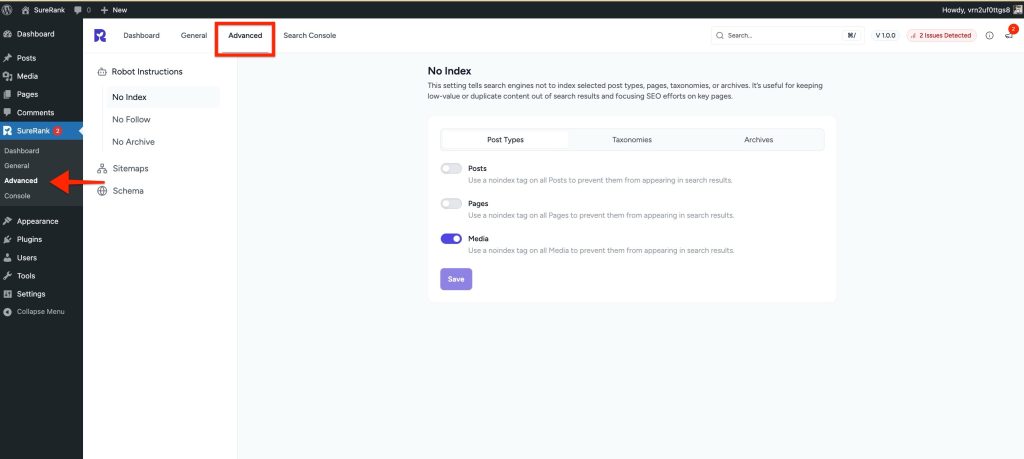
The Advanced tab in SureRank offers control over how search engines interact with your site’s content. It includes options like Robot Instructions, Sitemaps, and Schema settings to fine-tune your SEO strategy.
To access the Advanced Settings tab:
- Navigate to the left-side menu panel in your WordPress dashboard.
- Hover over SureRank.
- A menu will appear; click on Advanced Settings.
1. Robot Instructions
Under Robot Instructions, you can set rules for search engines using meta tags like noindex, nofollow, and noarchive. These controls are helpful for:
- Preventing low-value or duplicate content (e.g., media files or taxonomy pages) from being indexed.
- Conserving crawl budget by excluding unnecessary pages from search engine indexing.
- Ensuring only your most important content appears in search results.
What are Noindex, Nofollow, and Noarchive?
These are meta tags or robot instructions that guide search engines on how to treat specific pages on your website.
Noindex – Prevents a page from being shown in search engine results.
When to use:
- For low-value pages (like media attachment pages).
- On duplicate content (like printer-friendly versions).
- For pages you want private or hidden from public search.
Effect: Search engines will crawl the page but won’t include it in their index, so it won’t appear in search results.
Nofollow – Tells search engines not to follow links on the page.
When to use:
- On pages with untrusted or paid links.
- If you want to conserve crawl budget and focus it on more valuable links.
- To prevent passing link authority (PageRank) to other pages.
Effect: Search engines will see the page but will not crawl the links found on it.
Noarchive – Prevents search engines from showing a cached version of the page.
When to use:
- On time-sensitive content that changes frequently.
- For privacy reasons, where you don’t want users to access an old or saved version of the page via the “cached” link in search results.
Effect: The page can still appear in search results, but users won’t see the “cached” link next to it.
By setting these tags carefully in SureRank’s Advanced > Robot Instructions tab, you ensure that only your most valuable content is indexed, linked, and displayed the way you want in search engines.
2. Sitemaps
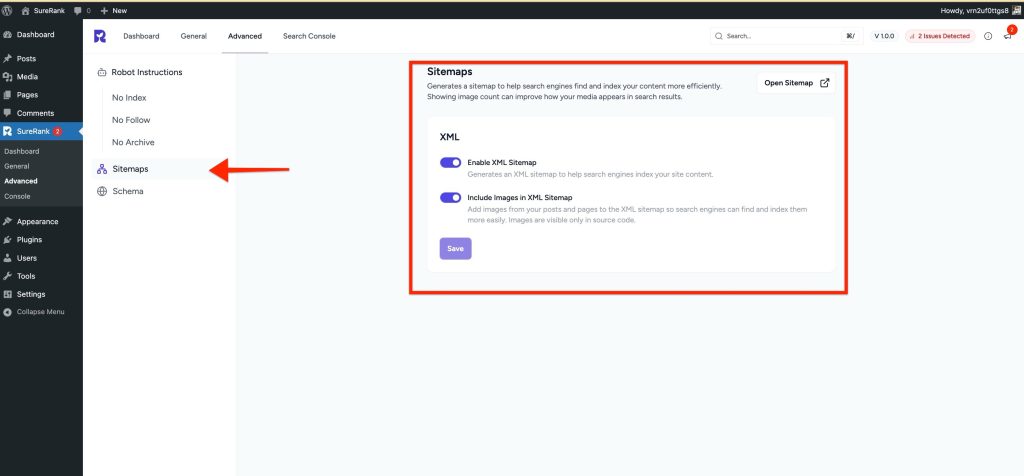
SureRank automatically generates optimized XML sitemaps that help search engines discover and crawl your website content efficiently. These sitemaps include your posts, pages, and custom post types.
Learn more about Sitemaps in SureRank: Sitemaps Documentation.
3. Schema
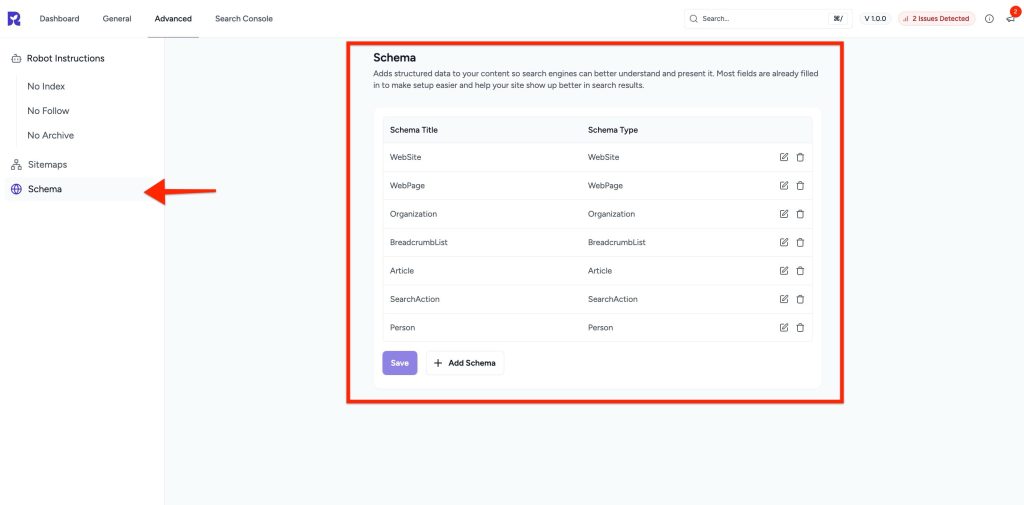
Schema markup helps search engines understand your content better and display rich results in search. SureRank allows you to configure Schema types for different content like articles, products, FAQs, and more, directly from your WordPress dashboard.
Learn how to configure Schema in SureRank: Schema Setup Documentation.
Make sure to review these settings under the Advanced tab to ensure your site’s SEO is aligned with your goals and optimized for search engine visibility.
We don't respond to the article feedback, we use it to improve our support content.